Lepidolite
| Lepidolite | |
|---|---|
 | |
| General | |
| Category | Phyllosilicate |
Formula .mw-parser-output .nobold{font-weight:normal} (repeating unit) | K(Li,Al)3(Al,Si,Rb)4O10(F,OH)2 |
| Strunz classification | 9.EC.20 |
| Crystal system | Monoclinic |
| Crystal class | Prismatic (2/m) (same H-M symbol) |
| Space group | C2/m, Cm |
| Unit cell | a = 5.209(2) Å, b = 9.011(5) Å, c = 10.149(5) Å; β = 100:77(4)°; Z = 2 |
| Identification | |
| Color | Pink, purple, rose-red, violet-gray, yellowish, white, colorless |
| Crystal habit | Tabular to prismatic pseudohexagonal crystals, scaly aggregates and massive |
| Twinning | Rare, composition plane {001} |
| Cleavage | {001} perfect |
| Fracture | Uneven |
Mohs scale hardness | 2.5–3 |
| Luster | Vitreous to pearly |
| Streak | White |
| Diaphaneity | Transparent to translucent |
| Specific gravity | 2.8–2.9 |
| Optical properties | Biaxial (-) |
| Refractive index | nα=1.525–1.548, nβ=1.551–1.58, nγ=1.554–1.586 |
| Birefringence | 0.0290–0.0380 |
| Pleochroism | X = almost colorless; Y = Z = pink, pale violet |
| 2V angle | 0° - 58° measured |
| References | [1][2] |
Lepidolite is a lilac-gray or rose-colored member of the mica group of minerals with formula K(Li,Al,Rb)2(Al,Si)4O10(F,OH)2.[1][2] It is the most abundant lithium-bearing mineral[3] and is a secondary source of this metal. It is a phyllosilicate mineral[4] and a member of the polylithionite-trilithionite series.[5]
It is associated with other lithium-bearing minerals like spodumene in pegmatite bodies. It is one of the major sources of the rare alkali metals rubidium and caesium.[6] In 1861, Robert Bunsen and Gustav Kirchhoff extracted 150 kg (330 lb) of lepidolite and yielded a few grams of rubidium salts for analysis, and therefore discovered the new element rubidium.[7]
It occurs in granite pegmatites, in some high-temperature quartz veins, greisens and granites. Associated minerals include quartz, feldspar, spodumene, amblygonite, tourmaline, columbite, cassiterite, topaz and beryl.[1]
Notable occurrences include Brazil; Ural Mountains, Russia; California, United States; Tanco Mine, Bernic Lake, Manitoba, Canada; and Madagascar.
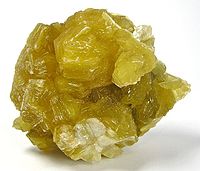
Yellow lepidolite from Itinga, Minas Gerais, Brazil. Size: 6.1 x 4.9 x 3.1 cm

Lavender lepidolite "books" from Himalaya Mine, Mesa Grande District, San Diego County, California, US. Size: 4.8 x 3.9 x 3.5 cm
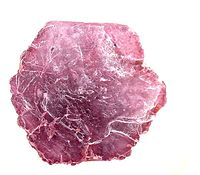
Lepidolite, Virgem da Lapa, Minas Gerais, Brazil (size 2.4 x 2.1 x 0.7 cm)

References
^ abc Handbook of Mineralogy
^ ab Webmineral
^ Deer, W.A.; Howie, R.A.; Zussman, J. (1966). An Introduction to the Rock Forming Minerals. London: Longman. p. 218. ISBN 0-582-44210-9..mw-parser-output cite.citation{font-style:inherit}.mw-parser-output .citation q{quotes:"""""""'""'"}.mw-parser-output .citation .cs1-lock-free a{background:url("//upload.wikimedia.org/wikipedia/commons/thumb/6/65/Lock-green.svg/9px-Lock-green.svg.png")no-repeat;background-position:right .1em center}.mw-parser-output .citation .cs1-lock-limited a,.mw-parser-output .citation .cs1-lock-registration a{background:url("//upload.wikimedia.org/wikipedia/commons/thumb/d/d6/Lock-gray-alt-2.svg/9px-Lock-gray-alt-2.svg.png")no-repeat;background-position:right .1em center}.mw-parser-output .citation .cs1-lock-subscription a{background:url("//upload.wikimedia.org/wikipedia/commons/thumb/a/aa/Lock-red-alt-2.svg/9px-Lock-red-alt-2.svg.png")no-repeat;background-position:right .1em center}.mw-parser-output .cs1-subscription,.mw-parser-output .cs1-registration{color:#555}.mw-parser-output .cs1-subscription span,.mw-parser-output .cs1-registration span{border-bottom:1px dotted;cursor:help}.mw-parser-output .cs1-ws-icon a{background:url("//upload.wikimedia.org/wikipedia/commons/thumb/4/4c/Wikisource-logo.svg/12px-Wikisource-logo.svg.png")no-repeat;background-position:right .1em center}.mw-parser-output code.cs1-code{color:inherit;background:inherit;border:inherit;padding:inherit}.mw-parser-output .cs1-hidden-error{display:none;font-size:100%}.mw-parser-output .cs1-visible-error{font-size:100%}.mw-parser-output .cs1-maint{display:none;color:#33aa33;margin-left:0.3em}.mw-parser-output .cs1-subscription,.mw-parser-output .cs1-registration,.mw-parser-output .cs1-format{font-size:95%}.mw-parser-output .cs1-kern-left,.mw-parser-output .cs1-kern-wl-left{padding-left:0.2em}.mw-parser-output .cs1-kern-right,.mw-parser-output .cs1-kern-wl-right{padding-right:0.2em}
^ Hurlbut, Cornelius S.; Klein, Cornelis (1985), Manual of Mineralogy, Wiley, (20th ed.)
ISBN 0-471-80580-7
^ Lepidolite on Mindat.org
^ H. Nechamkin, The Chemistry of the Elements, McGraw-Hill, New York, 1968.
^ G. Kirchhoff, R. Bunsen (1861). "Chemische Analyse durch Spectralbeobachtungen" (PDF). Annalen der Physik und Chemie. 189 (7): 337–381. Bibcode:1861AnP...189..337K. doi:10.1002/andp.18611890702.
 | Wikimedia Commons has media related to Lepidolite. |


