Lithopone
| Names | |
|---|---|
| Other names Barium zinc sulfate sulfide, Enamel White, Pigment white 5, CI Pigment white 5, Barium zinc sulfate, Barium zinc sulfide, Lithopone B301, ZNS 28-30%, Lithopone 28-30%, LithoponeB311, Zinc sulfide, Barium sulfate Mixture, Pigment White 5 (77115), Becton White, Charlton White, Zincolith, surya's salt | |
| Identifiers | |
| Properties | |
Chemical formula | BaSO4⋅ZnS{displaystyle {ce {BaSO4*ZnS}}} 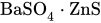 |
Molar mass | 330.80 g/mol |
| Appearance | White powder |
Odor | odorless |
Density | Approx. 4.36 g/mL |
Melting point | ZnS > 1,180°C BaSO4 > 1,350 °C |
Solubility in water | Insoluble |
| Hazards | |
NFPA 704 |  0 1 1 |
Except where otherwise noted, data are given for materials in their standard state (at 25 °C [77 °F], 100 kPa). | |
Infobox references | |
Lithopone, C.I. Pigment White 5, is a mixture of inorganic compounds, widely used as a white pigment powder. It is composed of a mixture of barium sulfate and zinc sulfide. These insoluble compounds blend well with organic compounds and confer opacity. It was made popular by the cheap production costs, greater coverage. Related white pigments include titanium dioxide, zinc oxide ("zinc white"), and zinc sulfide.[1][2]
Contents
1 History
1.1 Stability and darkening
2 Production
3 Safety
4 See also
5 References
6 Historical references
History
Lithopone was discovered in the 1870s by DuPont. It was manufactured by Krebs Pigments and Chemical Company and other companies.[3] The material came in different "seals", which varied in the content of zinc sulfide. Gold seal and Bronze seals contain 40-50% zinc sulfide, offering more hiding power and strength.[4][5] Although its popularity peaked around 1920, approximately 223,352 tons were produced in 1990. It is mainly used in paints, putty, and in plastics.[1]
Stability and darkening
Although barium sulfate is almost completely inert, zinc sulfide degrades upon exposure to UV light, leading to darkening of the pigment. The severity of this UV reaction is dependent on a combination of two factors; how much zinc sulfide makes up the pigments formulation, and its total accumulated UV exposure. Depending on these factors the pigment itself can vary in shade over time, ranging from pure white all the way to grey or even black. To suppress this effect, a dopant may be used, such as a small amount of cobalt salts, which would be added to the formulation. This process creates cobalt-doped zinc sulfide. The cobalt salts help to stabilize zinc sulfide so it will not have as severe a reaction to UV exposure.
Production
Lithopone is produced by coprecipitation of barium sulfate and zinc sulfide. Most commonly coprecipitation is effected by combining equimolar amounts of zinc sulfate and barium sulfide:
- BaS + ZnSO4→ ZnS · BaSO4
This route affords a product that is 29.4 wt % ZnS and 70.6 wt % BaSO4. Variations exist, for example, more ZnS-rich materials are produced when zinc chloride is added to the mixture of zinc sulfate and barium sulfide.[1]
Barium sulfide is produced by carbothermic reduction of barium sulfate. Zinc sulfate is obtained from a variety of zinc products, often waste, by treatment with sulfuric acid.
Safety
Lithopone is not highly poisonous, reflecting the insolubility of the components. Barium sulfate is used widely in medicine as a radiocontrast agent. Lithopone is allowed to be in contact with foodstuffs in the US and Europe.[1]
See also
- List of inorganic pigments
References
^ abcd Völz, Hans G. et al. "Pigments, Inorganic" in Ullmann's Encyclopedia of Industrial Chemistry, 2006 Wiley-VCH, Weinheim. doi:10.1002/14356007.a20_243.pub2.
^ Chemical Book. "Pigment White 5(1345-05-7)". Retrieved 29 April 2014..mw-parser-output cite.citation{font-style:inherit}.mw-parser-output .citation q{quotes:"""""""'""'"}.mw-parser-output .citation .cs1-lock-free a{background:url("//upload.wikimedia.org/wikipedia/commons/thumb/6/65/Lock-green.svg/9px-Lock-green.svg.png")no-repeat;background-position:right .1em center}.mw-parser-output .citation .cs1-lock-limited a,.mw-parser-output .citation .cs1-lock-registration a{background:url("//upload.wikimedia.org/wikipedia/commons/thumb/d/d6/Lock-gray-alt-2.svg/9px-Lock-gray-alt-2.svg.png")no-repeat;background-position:right .1em center}.mw-parser-output .citation .cs1-lock-subscription a{background:url("//upload.wikimedia.org/wikipedia/commons/thumb/a/aa/Lock-red-alt-2.svg/9px-Lock-red-alt-2.svg.png")no-repeat;background-position:right .1em center}.mw-parser-output .cs1-subscription,.mw-parser-output .cs1-registration{color:#555}.mw-parser-output .cs1-subscription span,.mw-parser-output .cs1-registration span{border-bottom:1px dotted;cursor:help}.mw-parser-output .cs1-ws-icon a{background:url("//upload.wikimedia.org/wikipedia/commons/thumb/4/4c/Wikisource-logo.svg/12px-Wikisource-logo.svg.png")no-repeat;background-position:right .1em center}.mw-parser-output code.cs1-code{color:inherit;background:inherit;border:inherit;padding:inherit}.mw-parser-output .cs1-hidden-error{display:none;font-size:100%}.mw-parser-output .cs1-visible-error{font-size:100%}.mw-parser-output .cs1-maint{display:none;color:#33aa33;margin-left:0.3em}.mw-parser-output .cs1-subscription,.mw-parser-output .cs1-registration,.mw-parser-output .cs1-format{font-size:95%}.mw-parser-output .cs1-kern-left,.mw-parser-output .cs1-kern-wl-left{padding-left:0.2em}.mw-parser-output .cs1-kern-right,.mw-parser-output .cs1-kern-wl-right{padding-right:0.2em}
^ "Krebs Pigment & Chemical Company". DuPont. Retrieved 2011-10-24.Founded in 1902 by Henrick J. Krebs, Krebs Pigments and Chemical Company produced lithopone, a widely used white paint pigment also manufactured by DuPont. But Krebs' company had another asset of special interest to DuPont. ...
^ Booge, J. E. (1929). "Lithopone Composition and Process of Making Same".
^ "Lithopone". 2010.
Historical references
Ralston, O.C. (1921). Electrolytic Deposition and Hydrometallurgy of Zinc. New York: McGraw Hill..
O'Brien, W.J. (1915). "The Study of Lithopone". J. Phys. Chem. 19 (2): 113–144. doi:10.1021/j150155a002..
US 1478347, Mitchell John L, "Apparatus for calcining lithopone", published Dec 18, 1923, assigned to Mitchell John L
Goshorn, J.H.; Black, C.K. (1929). "The study of lithopone darkening". Industrial and Engineering Chemistry. 21 (4): 348–9. doi:10.1021/ie50232a021.
Sachtleben. "Material Safety Data Sheet" (PDF). Retrieved 29 April 2014..
Trott, L.H. (1927). Lithopone and Its Part in Paints. The New Jersey Zinc Company..


