Antonine Itinerary
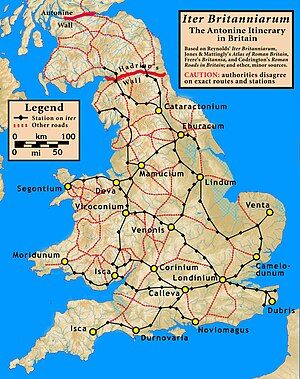
Iter Britanniarum, displayed as a road map. The plotted routes and stations are approximations. The Antonine Wall and Hadrian's Wall are shown.
The Antonine Itinerary (Latin: Itinerarium Antonini Augusti, lit. "The Itinerary of the Emperor Antoninus") is a famous itinerarium, a register of the stations and distances along various roads. Seemingly based on official documents, possibly from a survey carried out under Augustus, it describes the roads of the Roman Empire.[1] Owing to the scarcity of other extant records of this type, it is a valuable historical record.
Almost nothing is known of its date or author. Scholars consider it likely that the original edition was prepared at the beginning of the 3rd century. Although it is traditionally ascribed to the patronage of the 2nd-century Antoninus Pius, the oldest extant copy has been assigned to the time of Diocletian and the most likely imperial patron—if the work had one—would have been Caracalla.[1]
Contents
1 Iter Britanniarum
1.1 Examples
1.2 A confounding factor
2 Hispania
3 Citations
4 Bibliography
5 External links
Iter Britanniarum
The British section is known as the Iter Britanniarum, and can be described as the 'road map' of Roman Britain. There are 15 such itineraries in the document applying to different geographic areas.
The itinerary measures distances in Roman miles, where 1,000 Roman paces equals one Roman mile. A Roman pace was two steps, left plus right. Roman paces were not everywhere the same, and conversion to modern units is imprecise, but 1 Roman mile approximately equals 1,430 metres (4,690 ft).
Examples
Below are the original Latin ablative forms for sites along route 13,[2] followed by a translation with a possible (but not necessarily authoritative) name for the modern sites.[3] A transcriber omitted an entry, so that the total number of paces does not equal the sum of paces between locations.
| Item ab Isca Calleva mpm cviiii sic | A route from Isca Silurum to Calleva Atrebatum 109,000 paces thus |
|---|---|
Burrio mpm viii | Usk, Monmouthshire, 8,000 paces |
Blestio mpm xi | Monmouth, Monmouthshire 11,000 paces |
Ariconio mpm xi | Bury Hill, Weston under Penyard, Herefordshire 11,000 paces |
Clevo mpm xv | Gloucester, Gloucestershire 15,000 paces |
| (no entry) | perhaps Corinium Dobunnorum at modern Cirencester, Gloucestershire |
| Durocornovio mpm xiiii | perhaps Wanborough, Wiltshire 14,000 paces |
| Spinis mpm xv | Speen, Berkshire 15,000 paces |
Calleva mpm xv | Silchester, Hampshire 15,000 paces |
Below are the original Latin names for sites along route 14,[4] followed by a translation with a possible (but not necessarily authoritative) name for the modern sites.[3]
| Item alio itinere ab Isca Calleva mpm ciii sic | An alternate route from Isca Silurum to Calleva Atrebatum 103,000 paces thus |
|---|---|
Venta Silurum mpm viiii | Caerwent, Monmouthshire 9,000 paces |
| Abone mpm xiiii | Sea Mills, Gloucestershire 14,000 paces |
| Traiectus mpm viiii | perhaps Bitton, near Willsbridge, Gloucestershire 9,000 paces |
Aquis Solis mpm vi | Bath, Somerset 6,000 paces |
| Verlucione mpm xv | Sandy Lane, Wiltshire 15,000 paces |
Cunetione mpm xx | Mildenhall, Wiltshire 20,000 paces |
| Spinis mpm xv | Speen, Berkshire 15,000 paces |
Calleva mpm xv | Silchester, Hampshire 15,000 paces |
A confounding factor
De Situ Britanniae (made available c. 1749, published 1757) was a forgery that provided much spurious information on Roman Britain, including "itineraries" that overlapped the legitimate Antonine Itineraries, sometimes with contradicting information. Its authenticity was not seriously challenged until 1845, and it was still cited as an authoritative source until the late nineteenth century. By then, its false data had infected almost every account of ancient British history, and been adopted into the Ordnance Survey maps,[5] as General Roy and his successors believed it to be a legitimate source of information, on a par with the Antonine Itineraries. While the document is no longer cited, since its authenticity became indefensible, its data has not been systematically removed from past and present works.
Some authors, such as Thomas Reynolds, without challenging the authenticity of the forgery, took care to note its discrepancies and challenge the quality of its information.[6][7] This was not always so, even after the forgery was debunked.
Gonzalo Arias (died 2008) proposed that some of the distance anomalies in the British section of the Antonine Itinerary resulted from the loss of Latin grammatical endings, as these had marked junctions heading towards places, as distinct from the places themselves.[8] However, Arias may not have taken account of earlier work indicating that distances were measured between the edges of administrative areas of named settlements as opposed to centre-to-centre, thereby explaining supposed distance shortfalls and providing additional useful data on the approximate sizes of such areas.[9]
Hispania
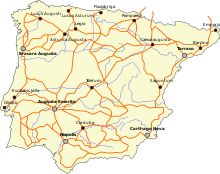
Hispania roads.
Citations
^ ab Chisholm, Hugh, ed. (1911). "Antonini Itinerarium". Encyclopædia Britannica. 2 (11th ed.). Cambridge University Press. p. 148..mw-parser-output cite.citation{font-style:inherit}.mw-parser-output q{quotes:"""""""'""'"}.mw-parser-output code.cs1-code{color:inherit;background:inherit;border:inherit;padding:inherit}.mw-parser-output .cs1-lock-free a{background:url("//upload.wikimedia.org/wikipedia/commons/thumb/6/65/Lock-green.svg/9px-Lock-green.svg.png")no-repeat;background-position:right .1em center}.mw-parser-output .cs1-lock-limited a,.mw-parser-output .cs1-lock-registration a{background:url("//upload.wikimedia.org/wikipedia/commons/thumb/d/d6/Lock-gray-alt-2.svg/9px-Lock-gray-alt-2.svg.png")no-repeat;background-position:right .1em center}.mw-parser-output .cs1-lock-subscription a{background:url("//upload.wikimedia.org/wikipedia/commons/thumb/a/aa/Lock-red-alt-2.svg/9px-Lock-red-alt-2.svg.png")no-repeat;background-position:right .1em center}.mw-parser-output .cs1-subscription,.mw-parser-output .cs1-registration{color:#555}.mw-parser-output .cs1-subscription span,.mw-parser-output .cs1-registration span{border-bottom:1px dotted;cursor:help}.mw-parser-output .cs1-hidden-error{display:none;font-size:100%}.mw-parser-output .cs1-visible-error{font-size:100%}.mw-parser-output .cs1-subscription,.mw-parser-output .cs1-registration,.mw-parser-output .cs1-format{font-size:95%}.mw-parser-output .cs1-kern-left,.mw-parser-output .cs1-kern-wl-left{padding-left:0.2em}.mw-parser-output .cs1-kern-right,.mw-parser-output .cs1-kern-wl-right{padding-right:0.2em}
^ Parthey 1848:232–33 in Britannia
^ ab Codrington 1918, In Roman Roads in Britain
^ Parthey 1848:233 in Britannia
^ Redmonds, George (2004), Names and History: People, Places and Things, Hambledon & London, pp. 65–68, ISBN 1-85285-426-X
A Major Place-Name Ignored
^ Reynolds 1799 Iter Britanniarum
^ Dyer 1816 Vulgar Errors, Ancient and Modern
^ For most Roman roads in Hispania, see Gonzalo Arias. "El Miliario Extravagante". Archived from the original on 2011-07-25. Retrieved 2012-08-27.. Cf. also his Grammar in the Antonine Itinerary: A Challenge to British Archaeologists (available in only a few libraries).
^ Cf. Rodwell, "Milestones, Civic Territories and the Antonine Itinerary", 6 Britannia 76-101 (1975).
 Chisholm, Hugh, ed. (1911). "Antonini Itinerarium". Encyclopædia Britannica. 2 (11th ed.). Cambridge University Press. p. 148..mw-parser-output cite.citation{font-style:inherit}.mw-parser-output q{quotes:"""""""'""'"}.mw-parser-output code.cs1-code{color:inherit;background:inherit;border:inherit;padding:inherit}.mw-parser-output .cs1-lock-free a{background:url("//upload.wikimedia.org/wikipedia/commons/thumb/6/65/Lock-green.svg/9px-Lock-green.svg.png")no-repeat;background-position:right .1em center}.mw-parser-output .cs1-lock-limited a,.mw-parser-output .cs1-lock-registration a{background:url("//upload.wikimedia.org/wikipedia/commons/thumb/d/d6/Lock-gray-alt-2.svg/9px-Lock-gray-alt-2.svg.png")no-repeat;background-position:right .1em center}.mw-parser-output .cs1-lock-subscription a{background:url("//upload.wikimedia.org/wikipedia/commons/thumb/a/aa/Lock-red-alt-2.svg/9px-Lock-red-alt-2.svg.png")no-repeat;background-position:right .1em center}.mw-parser-output .cs1-subscription,.mw-parser-output .cs1-registration{color:#555}.mw-parser-output .cs1-subscription span,.mw-parser-output .cs1-registration span{border-bottom:1px dotted;cursor:help}.mw-parser-output .cs1-hidden-error{display:none;font-size:100%}.mw-parser-output .cs1-visible-error{font-size:100%}.mw-parser-output .cs1-subscription,.mw-parser-output .cs1-registration,.mw-parser-output .cs1-format{font-size:95%}.mw-parser-output .cs1-kern-left,.mw-parser-output .cs1-kern-wl-left{padding-left:0.2em}.mw-parser-output .cs1-kern-right,.mw-parser-output .cs1-kern-wl-right{padding-right:0.2em}
Bibliography
.mw-parser-output .refbegin{font-size:90%;margin-bottom:0.5em}.mw-parser-output .refbegin-hanging-indents>ul{list-style-type:none;margin-left:0}.mw-parser-output .refbegin-hanging-indents>ul>li,.mw-parser-output .refbegin-hanging-indents>dl>dd{margin-left:0;padding-left:3.2em;text-indent:-3.2em;list-style:none}.mw-parser-output .refbegin-100{font-size:100%}
- The standard modern edition of the Itinerary is in O. Cuntz, Itineraria Romana, vol. 1: Itineraria Antonini Augusti et Burdigalense (Leipzig 1929), nos, 1 – 75 (terrestrial), 76 – 85 (maritime).
- The first edition was by Geoffroy Troy: Torinus, Godofredus, ed. (1512), Itinerarivm prouinciarum omniu[m] Antonini Augusti : cum fragmento eiusdem necnon indice haud quaq[ue] asperna[n]do, Paris: Henricus Stephanus, retrieved 5 January 2016
- Bernd Löhberg, Das 'Itinerarium provinciarum Antonini Augusti' (2006)
Chisholm, Hugh, ed. (1910), Encyclopædia Britannica, II (Eleventh ed.), Cambridge
Codrington, Thomas (1918), Roman Roads in Britain (Third ed.), London: Society for Promoting Christian Knowledge (published 1919)
Dyer, Gilbert (1816), Vulgar Errors, Ancient and Modern, Gilbert Dyer
Parthey, Gustav; Pinder, Moritz, eds. (1848), Itinerarium Antonini Augusti et Hierosolymitanum, Berlin
Reynolds, Thomas (1799), Iter Britanniarum, Cambridge
External links
 | Latin Wikisource has original text related to this article: Antonine Itinerary |
- The Antonine Itinerary: Iter Britanniarum - The British Section
- Analysis of the Itinerary
Itinerarium Antonini Augusti (the Balkanic roads) at SOLTDM.COM- Roman Roads in Britain


