1983 United Kingdom general election
 | |||||||||||||||||||||||||||||||||||||||||||||||||||||
All 650 seats in the House of Commons 326 seats needed for a majority | |||||||||||||||||||||||||||||||||||||||||||||||||||||
|---|---|---|---|---|---|---|---|---|---|---|---|---|---|---|---|---|---|---|---|---|---|---|---|---|---|---|---|---|---|---|---|---|---|---|---|---|---|---|---|---|---|---|---|---|---|---|---|---|---|---|---|---|---|
| Opinion polls | |||||||||||||||||||||||||||||||||||||||||||||||||||||
| Turnout | 72.7%,  3.3% 3.3% | ||||||||||||||||||||||||||||||||||||||||||||||||||||
| |||||||||||||||||||||||||||||||||||||||||||||||||||||
 Colours denote the winning party—as shown in § Results | |||||||||||||||||||||||||||||||||||||||||||||||||||||
| |||||||||||||||||||||||||||||||||||||||||||||||||||||


 38[a]
38[a]The 1983 United Kingdom general election was held on Thursday 9 June 1983. It gave the Conservative Party under the leadership of Margaret Thatcher the most decisive election victory since that of the Labour Party in 1945.
Thatcher's first four years as Prime Minister had not been an easy time.[1] Unemployment increased during the first three years of her premiership and the economy went through a recession. However, the British victory in the Falklands War led to a recovery of her personal popularity; the economy had also returned to growth. By the time Thatcher called the election in May 1983, the Conservatives were most people's firm favourites to win the general election.[2] The Labour Party had been led by Michael Foot since the resignation of former Prime Minister James Callaghan in 1980. They had fared well in opinion polls and local elections during this time, but issues developed which would lead directly to their defeat. Labour adopted a platform that was considered more left-wing than usual.[2][3] Several moderate Labour MPs had defected from the party to form the Social Democratic Party (SDP); they then formed the SDP–Liberal Alliance with the existing Liberal Party.
The opposition vote split almost evenly between the Alliance and Labour. With its worst electoral performance since 1918, the Labour vote fell by over 3 million votes from 1979 and this accounted for both a national swing of almost 4% towards the Conservatives and their larger parliamentary majority of 144 seats, even though the Conservatives' total vote fell by almost 700,000. This was the last general election where a governing party increased its number of seats until 2015.
The Alliance finished in third place but came within 700,000 votes of out-polling Labour. By gaining 25% of the popular vote, the Alliance won the largest such percentage for any third party since the 1923 general election. Despite this, they won only 23 seats, whereas Labour won 209. The Liberals argued that a proportional electoral system would have given them a more representative number of MPs. Changing the electoral system had been a long-running Liberal Party campaign plank and would later be adopted by the Liberal Democrats.
The election night was broadcast live on the BBC, and was presented by David Dimbleby, Sir Robin Day and Peter Snow.[4] It was also broadcast on ITV, and presented by Alastair Burnet, Peter Sissons and Martyn Lewis.
Three future Leaders of the Labour Party (Tony Blair, Gordon Brown and Jeremy Corbyn) were first elected as Members of Parliament at this election—two of them would later hold the office of Prime Minister, whilst Corbyn became Labour leader in 2015. Former Labour Prime Minister Harold Wilson, Shirley Williams, Bill Rodgers, Joan Lestor and Tony Benn left Parliament as a result of this election, although Benn would return in a by-election the following year, and Lestor at the following general election.
|
|
|
|
|
Contents
1 Background and campaign
2 Notional election, 1979
3 Timeline
4 Results
4.1 Votes summary
4.2 Seats summary
5 Incumbents defeated
5.1 Labour
5.2 Social Democratic Party
5.3 Independent Labour
5.4 Sinn Féin
5.5 Social Democratic and Labour Party
5.6 Liberal Party
5.7 Conservative
6 Target tables
6.1 Conservative targets
6.2 Labour targets
6.3 SDP–Liberal Alliance targets
7 See also
8 Notes
9 References
10 Further reading
11 Manifestos
Background and campaign
Michael Foot was elected leader of the Labour Party in 1980, replacing James Callaghan. The election of Foot signalled that the core of the party was swinging to the left and the move exacerbated divisions within the party. In 1981 a group of senior figures including Roy Jenkins, David Owen, Bill Rodgers and Shirley Williams left Labour to found the Social Democratic Party (SDP). The SDP agreed to a pact with the Liberals for the 1983 election and stood as "The Alliance".
The campaign displayed the huge divisions between the two major parties. Thatcher had been highly unpopular during her first two years in office until the swift and decisive victory in the Falklands War, coupled with an improving economy, considerably raised her standings in the polls. The Conservatives' key issues included employment, economic growth and defence. Labour's campaign manifesto involved leaving the European Economic Community, abolishing the House of Lords, abandoning the United Kingdom's nuclear deterrent by cancelling Trident and removing cruise missiles—a programme dubbed by Labour MP Gerald Kaufman "the longest suicide note in history"; "Although, at barely 37 pages, it only seemed interminable", noted Roy Hattersley. Pro-Labour political journalist Michael White, writing in The Guardian, commented: "There was something magnificently brave about Michael Foot's campaign but it was like the Battle of the Somme."[5]
Notional election, 1979
Following boundary changes in 1983, the BBC and ITN (Independent Television News) co-produced a calculation of how the 1979 general election would have gone if fought on the new 1983 boundaries. The following table shows the effects of the boundary changes on the House of Commons:
| Party | Seats | Gains | Losses | Net gain/loss | Seats % | Votes % | Votes | +/− | |
|---|---|---|---|---|---|---|---|---|---|
| | Conservative | 359 | +20 | 55 | 44.9 | 13,703,429 | |||
| | Labour | 261 | −8 | 40 | 37.7 | 11,512,877 | |||
| | Liberal | 9 | −2 | 1 | 14.2 | 4,324,936 | |||
| | SNP | 2 | 0 | 0 | 1.6 | 497,128 | |||
| | Plaid Cymru | 2 | 0 | 0 | 0.4 | 135,241 | |||
| | Other parties | 17 | +5 | 3 | 3.4 | 1,063,263 | |||
Timeline
Prime Minister Margaret Thatcher visited Buckingham Palace on the afternoon of 9 May and asked the Queen to dissolve Parliament on 13 May, announcing that the election would be held on 9 June. The key dates were as follows:
| Friday 13 May | Dissolution of the 48th Parliament and campaigning officially begins |
| Monday 23 May | Last day to file nomination papers; 2,579 candidates enter |
| Wednesday 8 June | Campaigning officially ends |
| Thursday 9 June | Polling day |
| Friday 10 June | The Conservative Party wins with a majority of 144 to retain power |
| Wednesday 15 June | 49th Parliament assembles |
| Wednesday 22 June | State Opening of Parliament |
Results
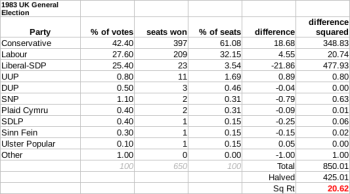
The election saw a landslide victory for the Conservatives, achieving their best results since 1935. Although there was a slight drop in their share of the vote, they made significant gains at the expense of Labour. The night was a disaster for the Labour Party; their share of the vote fell by over 9%, which meant they were only 700,000 votes ahead of the newly-formed third party, the SDP–Liberal Alliance. The massive increase of support for the Alliance at the expense of Labour meant that, in many seats,[which?] the collapse in the Labour vote allowed the Conservatives to gain. Despite winning over 25% of the national vote, the Alliance got fewer than 4% of seats, 186 fewer than Labour. The most significant Labour loss of the night was Tony Benn, who was defeated in the revived Bristol East seat. SDP President Shirley Williams, then a prominent leader in the Social Democratic Party, lost her Crosby seat which she had won in a by-election in 1981. Bill Rodgers, another leading figure in the Alliance (like Williams, one of the "Gang of Four") also failed to win his old seat that he previously held as a Labour MP.
In Scotland, both Labour and the Tories sustained modest losses to the Alliance. Labour remained by far the largest party, with 41 seats to 21 for the Scottish Conservatives. The Scottish Conservatives have been unable to match their 1983 Westminster seat total since, although they did record a slightly larger share of the Scottish vote in 2017.
397 | 209 | 23 | 21 |
Conservative | Labour | Alliance | O |
| Candidates | Votes | ||||||||||
|---|---|---|---|---|---|---|---|---|---|---|---|
| Party | Leader | Stood | Elected | Gained | Unseated | Net | % of total | % | No. | Net % | |
| | Conservative | Margaret Thatcher | 633 | 397 | 47 | 10 | +37 | 61.1 | 42.4 | 13,012,316 | −1.5 |
| | Labour | Michael Foot | 633 | 209 | 4 | 55 | −51 | 32.2 | 27.6 | 8,456,934 | −9.3 |
| | SDP–Liberal Alliance | David Steel & Roy Jenkins | 636[b] | 23 | 12 | 0 | +12 | 4.5 | 25.4 | 7,794,770 | +11.6 |
| | SNP | Gordon Wilson | 72 | 2 | 0 | 0 | 0 | 0.3 | 1.1 | 331,975 | −0.5 |
| | UUP | James Molyneaux | 16 | 11 | 3 | 1 | +2 | 1.7 | 0.8 | 259,952 | 0.0 |
| | DUP | Ian Paisley | 14 | 3 | 2 | 1 | +1 | 0.5 | 0.5 | 152,749 | +0.3 |
| | SDLP | John Hume | 17 | 1 | 0 | 1 | −1 | 0.2 | 0.4 | 137,012 | 0.0 |
| | Plaid Cymru | Dafydd Wigley | 38 | 2 | 0 | 0 | 0 | 0.3 | 0.4 | 125,309 | 0.0 |
| | Sinn Féin | Ruairí Ó Brádaigh | 14 | 1 | 1 | 1 | 0 | 0.2 | 0.3 | 102,701 | N/A |
| | Alliance | Oliver Napier | 12 | 0 | 0 | 0 | 0 | 0.0 | 0.2 | 61,275 | −0.1 |
| | Ecology | Jonathon Porritt | 109 | 0 | 0 | 0 | 0 | 0.0 | 0.2 | 54,299 | +0.1 |
| | Independent | N/A | 73 | 0 | 0 | 0 | 0 | 0.0 | 0.1 | 30,422 | N/A |
| | National Front | Andrew Brons | 60 | 0 | 0 | 0 | 0 | 0.0 | 0.1 | 27,065 | −0.5 |
| | UPUP | James Kilfedder | 1 | 1 | 1 | 0 | +1 | 0.2 | 0.1 | 22,861 | N/A |
| | Independent Labour | N/A | 8 | 0 | 0 | 0 | 0 | 0.0 | 0.1 | 16,447 | 0.0 |
| | Workers' Party | Tomás Mac Giolla | 14 | 0 | 0 | 0 | 0 | 0.0 | 0.0 | 14,650 | −0.1 |
| | BNP | John Tyndall | 54 | 0 | 0 | 0 | 0 | 0.0 | 0.0 | 14,621 | N/A |
| | Communist | Gordon McLennan | 35 | 0 | 0 | 0 | 0 | 0.0 | 0.0 | 11,606 | −0.1 |
| | Independent Socialist | N/A | 1 | 0 | 0 | 0 | 0 | 0.0 | 0.0 | 10,326 | N/A |
| | Ind. Conservative | N/A | 10 | 0 | 0 | 0 | 0 | 0.0 | 0.0 | 9,442 | 0.0 |
| | Independent Communist | N/A | 2 | 0 | 0 | 0 | 0 | 0.0 | 0.0 | 4,760 | N/A |
| | Workers Revolutionary | Michael Banda | 21 | 0 | 0 | 0 | 0 | 0.0 | 0.0 | 3,798 | −0.1 |
| | Monster Raving Loony | Screaming Lord Sutch | 11 | 0 | 0 | 0 | 0 | 0.0 | 0.0 | 3,015 | N/A |
| | Wessex Regionalist | N/A | 10 | 0 | 0 | 0 | 0 | 0.0 | 0.0 | 1,750 | 0.0 |
| | Mebyon Kernow | Richard Jenkin | 2 | 0 | 0 | 0 | 0 | 0.0 | 0.0 | 1,151 | N/A |
| | Independent DUP | N/A | 1 | 0 | 0 | 0 | 0 | 0.0 | 0.0 | 1,134 | N/A |
| | Licensees | N/A | 4 | 0 | 0 | 0 | 0 | 0.0 | 0.0 | 934 | N/A |
| | Nationalist Party | N/A | 5 | 0 | 0 | 0 | 0 | 0.0 | 0.0 | 874 | N/A |
| | Labour and Trade Union | Peter Hadden | 1 | 0 | 0 | 0 | 0 | 0.0 | 0.0 | 584 | N/A |
| | Revolutionary Communist | Frank Furedi | 4 | 0 | 0 | 0 | 0 | 0.0 | 0.0 | 581 | N/A |
| | Freedom Party | N/A | 1 | 0 | 0 | 0 | 0 | 0.0 | 0.0 | 508 | N/A |
Government's new majority | 144 |
| Total votes cast | 30,671,137 |
| Turnout | 72.7% |
Votes summary

Seats summary
@media all and (max-width:720px){.mw-parser-output .mobile-float-reset{float:none!important;width:100%!important}}.mw-parser-output .stack-container{box-sizing:border-box}.mw-parser-output .stack-clear-left{float:left;clear:left}.mw-parser-output .stack-clear-right{float:right;clear:right}.mw-parser-output .stack-left{float:left}.mw-parser-output .stack-right{float:right}.mw-parser-output .stack-object{margin:1px;overflow:hidden}

Conservative Labour | Alliance Others |
Incumbents defeated
Labour
Tony Benn (Bristol East), former Secretary of State for Energy (1975–1979)
Albert Booth (Barrow and Furness), former Secretary of State for Employment (1976–1979)
Arthur Davidson (Accrington), Shadow Attorney General for England and Wales
Neil Carmichael (Glasgow Kelvingrove)
Joseph Dean (Leeds West), former Government Whip (1978–1979)
David Ennals (Norwich North), former Secretary of State for Social Services (1976–1979)
John Garrett (Norwich South)
Edward Graham (Edmonton), former Lord Commissioner of the Treasury (1976–1979)
William Homewood (Kettering)
Frank Hooley (Sheffield Heeley)
Douglas Jay (Battersea North), former President of the Board of Trade
Russell Kerr (Feltham and Heston)
Joan Lester (Eton and Slough)
Alex Lyon (York)
Jim Marshall (Leicester South)
Roland Moyle (Lewisham East), former Minister of State for Health
Stan Newens (Harlow)
Ossie O'Brien (Darlington)
Christopher Price (Lewisham West)
Gwilym Roberts (Cannock)
John Sever (Birmingham Ladywood, stood in Meriden)
John Spellar (Birmingham Northfield, by-election win)
David Stoddart (Swindon)
Ann Taylor (Bolton West), former Assistant Government Whip (1977–1979)
John Tilley (Lambeth Central)
Frank White (Bury and Radcliffe)
Phillip Whitehead (Derby North)
William Whitlock (Nottingham North)
Kenneth Woolmer (Batley and Morley)
Social Democratic Party
Tom Bradley (Leicester East)
Christopher Brocklebank-Fowler (North West Norfolk), only Conservative MP to join SDP
Ronald Brown (Hackney South and Shoreditch)
Richard Crawshaw (Liverpool Toxteth), former Second Deputy Chairmen of Ways and Means (1979–1981)
George Cunningham (Islington South and Finsbury)
Tom Ellis (Wrexham)
David Ginsburg (Dewsbury)
John Grant (Islington Central)
Ednyfed Hudson Davies (Caerphilly)
Edward Lyons (Bradford West)
Dickson Mabon (Greenock and Port Glasgow), former Minister for Energy (1976–1979)
Tom McNally (Stockport South)
Bryan Magee (Leyton)
Bob Mitchell (Southampton Itchen)
Eric Ogden (Liverpool West Derby)
William Rodgers (Stockton-on-Tees), former Secretary of State for Transport (1976–1979)
John Roper (Farnworth), Chief Whip, Social Democrat Party (from 1981)
Neville Sandelson (Hayes and Harlington)
Jeffrey Thomas (Abertillery)
Michael Thomas (Newcastle-upon-Tyne East)
James Wellbeloved (Erith and Crayford)
Shirley Williams (Crosby), former Secretary of State for Education and Science (1976–1979), President of the Social Democratic Party (from 1982)
Independent Labour
Ben Ford (Bradford North), formerly Labour, stood as independent after being de-selected
Arthur Lewis (Newham North West), formerly Labour, stood as independent after being de-selected
Michael O'Halloran (Islington North), formerly Labour and SDP but stood as independent when not selected for seat
Sinn Féin
Owen Carron (Fermanagh and South Tyrone)
Social Democratic and Labour Party
Gerry Fitt (Belfast West)
Liberal Party
Bill Pitt (Croydon North West)
Conservative
David Myles (Banffshire), contested Orkney and Shetland
Iain Sproat (Aberdeen South), contested Roxburgh and Berwickshire
Delwyn Williams (Montgomeryshire)
Hamish Gray (Ross and Cromarty), Minister of State for Energy
Target tables
Conservative targets
| Rank | Constituency | 1983 winner | |
|---|---|---|---|
| 1 | Isle of Wight | SDP–Liberal Alliance | |
| 2 | Oxford East | Conservative | |
| 3 | Cunninghame North | Conservative | |
| 4 | Corby | Conservative | |
| 5 | Nottingham East | Conservative | |
| 6 | Hertfordshire West | Conservative | |
| 7 | Mitcham and Morden | Conservative | |
| 8 | Derbyshire South | Conservative | |
| 9 | Leicestershire North West | Conservative | |
| 10 | Southampton Itchen | Conservative | |
| 11 | Halifax | Conservative | |
| 12 | Stockton South | SDP–Liberal Alliance | |
| 13 | Lewisham West | Conservative | |
| 14 | Edmonton | Conservative | |
| 15 | Stevenage | Conservative | |
| 16 | York | Conservative | |
| 17 | Darlington | Conservative | |
| 18 | Ceredigion and Pembroke North | SDP–Liberal Alliance | |
| 19 | Inverness, Nairn and Lochaber | SDP–Liberal Alliance | |
| 20 | Bridgend | Conservative | |
Labour targets
To regain an overall majority, Labour needed to make at least 65 gains.
| Rank | Constituency | 1983 winner | |
|---|---|---|---|
| 1 | Birmingham Northfield | Conservative | |
| 2 | Bury South | Conservative | |
| 3 | Dulwich | Conservative | |
| 4 | Liverpool Broadgreen | Labour | |
| 5 | Nottingham South | Conservative | |
| 6 | Aberdeen South | Conservative | |
| 7 | Stirling | Conservative | |
| 8 | Hornchurch | Conservative | |
| 9 | Luton South | Conservative | |
| 10 | Calder Valley | Conservative | |
| 11 | Pendle | Conservative | |
| 12 | Bolton North East | Conservative | |
| 13 | Cardiff Central | Conservative | |
| 14 | Croydon North West | Conservative | |
| 15 | Fulham | Conservative | |
| 16 | Cambridge | Conservative | |
| 17 | Birmingham Erdington | Labour | |
| 18 | Dudley West | Conservative | |
| 19 | Welwyn Hatfield | Conservative | |
| 20 | Glasgow Cathcart | Labour | |
SDP–Liberal Alliance targets
| Rank | Constituency | 1983 winner | |
|---|---|---|---|
| 1 | Roxburgh and Berwickshire | SDP–Liberal Alliance | |
| 2 | Richmond and Barnes | Conservative | |
| 3 | Montgomeryshire | SDP–Liberal Alliance | |
| 4 | Chelmsford | Conservative | |
| 5 | Wiltshire North | Conservative | |
| 6 | Cornwall North | Conservative | |
| 7 | Hereford | Conservative | |
| 8 | Colne Valley | SDP–Liberal Alliance | |
| 9 | Gordon | SDP–Liberal Alliance | |
| 10 | Southport | Conservative | |
| 11 | Salisbury | Conservative | |
| 12 | Devon North | Conservative | |
| 13 | Gainsborough and Horncastle | Conservative | |
| 14 | Cornwall South East | Conservative | |
| 15 | Clwyd South West | Conservative | |
| 16 | Liverpool Broadgreen | Labour | |
| 17 | Newbury | Conservative | |
| 18 | Yeovil | SDP–Liberal Alliance | |
| 19 | Pudsey | Conservative | |
| 20 | Ross, Cromarty and Skye | SDP–Liberal Alliance | |
See also
- MPs elected in the United Kingdom general election, 1983
Notes
^ abc Indicates boundary change—so this is a nominal figure.
^ Includes official Liberal candidates who were not given national Alliance endorsement in three constituencies: Liverpool Broadgreen, Hackney South and Shoreditch, and Hammersmith.
^ The SDP–Liberal Alliance vote is compared with the Liberal Party vote in the 1979 election.
^ The Independent Unionist elected in the 1979 election defended and held his seat for the Ulster Popular Unionist Party. The United Ulster Unionist Party dissolved and its sole MP did not re-stand.
^ The Independent Republican elected in the 1979 election died in 1981. In the ensuring by-election the seat was won by Bobby Sands, an Anti-H-Block/Armagh Political Prisoner who then died and was succeeded by an Anti-H-Block Proxy Political Prisoner candidate Owen Carron. He defended and lost his seat standing for Sinn Féin who contested seats in Northern Ireland for the first time since 1959.
^ This election was fought under revised boundaries. The changes reflect those comparing to the notional results on the new boundaries. One significant change was the increase in the number of seats allocated to Northern Ireland from 12 to 17.
References
^ "Baroness Margaret Thatcher", gov.uk, retrieved 2 July 2018.mw-parser-output cite.citation{font-style:inherit}.mw-parser-output .citation q{quotes:"""""""'""'"}.mw-parser-output .citation .cs1-lock-free a{background:url("//upload.wikimedia.org/wikipedia/commons/thumb/6/65/Lock-green.svg/9px-Lock-green.svg.png")no-repeat;background-position:right .1em center}.mw-parser-output .citation .cs1-lock-limited a,.mw-parser-output .citation .cs1-lock-registration a{background:url("//upload.wikimedia.org/wikipedia/commons/thumb/d/d6/Lock-gray-alt-2.svg/9px-Lock-gray-alt-2.svg.png")no-repeat;background-position:right .1em center}.mw-parser-output .citation .cs1-lock-subscription a{background:url("//upload.wikimedia.org/wikipedia/commons/thumb/a/aa/Lock-red-alt-2.svg/9px-Lock-red-alt-2.svg.png")no-repeat;background-position:right .1em center}.mw-parser-output .cs1-subscription,.mw-parser-output .cs1-registration{color:#555}.mw-parser-output .cs1-subscription span,.mw-parser-output .cs1-registration span{border-bottom:1px dotted;cursor:help}.mw-parser-output .cs1-ws-icon a{background:url("//upload.wikimedia.org/wikipedia/commons/thumb/4/4c/Wikisource-logo.svg/12px-Wikisource-logo.svg.png")no-repeat;background-position:right .1em center}.mw-parser-output code.cs1-code{color:inherit;background:inherit;border:inherit;padding:inherit}.mw-parser-output .cs1-hidden-error{display:none;font-size:100%}.mw-parser-output .cs1-visible-error{font-size:100%}.mw-parser-output .cs1-maint{display:none;color:#33aa33;margin-left:0.3em}.mw-parser-output .cs1-subscription,.mw-parser-output .cs1-registration,.mw-parser-output .cs1-format{font-size:95%}.mw-parser-output .cs1-kern-left,.mw-parser-output .cs1-kern-wl-left{padding-left:0.2em}.mw-parser-output .cs1-kern-right,.mw-parser-output .cs1-kern-wl-right{padding-right:0.2em}
^ ab 1983: Thatcher triumphs again, BBC News, 5 April 2005, retrieved 22 March 2015
^ Vaidyanathan, Rajini (4 March 2010), "Michael Foot: What did the 'longest suicide note' say?", BBC News Magazine, BBC News, retrieved 22 March 2015
^ Election 1983 – Part 1 on YouTube
^ White, Michael (11 April 2005), "Michael White on 35 years of covering elections", The Guardian, retrieved 23 June 2018
Further reading
Butler, David E.; et al. (1984), The British General Election of 1983, the standard scholarly study
Craig, F. W. S. (1989), British Electoral Facts: 1832–1987, Dartmouth: Gower, ISBN 0900178302
Clarke, Harold D.; Mishler, William; Whiteley, Paul (1990), "Recapturing the Falklands: models of Conservative popularity, 1979–83", British Journal of Political Science, 20 (1): 63–81
Manifestos
The Challenge of Our Times, 1983 Conservative Party manifesto
The New Hope for Britain, 1983 Labour Party manifesto
Working Together for Britain, 1983 SDP–Liberal Alliance manifesto
 Elections and referendums in the United Kingdom Elections and referendums in the United Kingdom | |
|---|---|
| General elections |
|
| Local elections |
|
| European elections |
|
| Referendums |
|
Margaret Thatcher | |||||
|---|---|---|---|---|---|
| |||||
| Member of Parliament |
|  | |||
| Ideology |
| ||||
| Premiership |
| ||||
| Party elections |
| ||||
| General elections |
| ||||
| Books |
| ||||
| Family |
| ||||
| Cultural depictions |
| ||||
| |||||
 Book
Book Category
 Honours

