NJ Transit Rail Operations
 | |
 | |
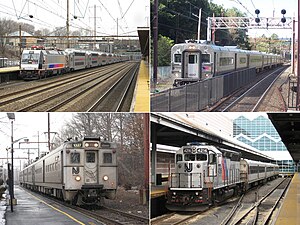 NJ Transit provides rail service throughout northern New Jersey, between Philadelphia and Atlantic City in southern New Jersey, and in the lower Hudson Valley west of the Hudson River. | |
| Reporting mark | NJTR |
|---|---|
| Locale | North and Central Jersey, White Horse Pike corridor, Hudson Valley |
| Dates of operation | 1983–present |
| Track gauge | 4 ft 8 1⁄2 in (1,435 mm) standard gauge |
| Electrification | 12.5 kV 25 Hz AC Catenary 25 kV 60 Hz AC Catenary |
| Headquarters | 1 Penn Plaza East Newark, NJ 07105 |
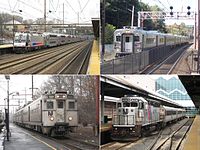
NJ Transit Rail Operations (reporting mark NJTR) is the rail division of NJ Transit. It operates commuter rail service in New Jersey, with most service centered on transportation to and from New York City, Hoboken, and Newark. NJ Transit also operates rail service in Orange and Rockland counties in New York under contract to Metro-North Railroad. The commuter rail lines had an average weekday ridership of 306,892 from June 1, 2015 to June 30, 2016.[1] This does not include NJ Transit's light rail operations.
Contents
1 Network and infrastructure
1.1 Lines
1.1.1 Current lines
1.1.2 Freight usage
1.1.3 Non-passenger lines
1.2 Ownership
1.3 Yards and maintenance
1.4 Movable bridges
2 Rolling stock
2.1 Reporting marks
2.2 Locomotives
2.2.1 Active revenue
2.2.2 Retired revenue
2.2.3 Non-revenue
2.3 Passenger cars
3 Stations
4 References
5 External links
Network and infrastructure
Lines
As of 2012[update], NJ Transit's commuter rail network consists of 11 lines and 164 stations,[2] primarily concentrated in northern New Jersey, with one line running between Atlantic City and Philadelphia.
Current lines
Operations are in two divisions:
Hoboken Division, formerly operated by the Erie Lackawanna Railroad, runs from Hoboken Terminal or through Newark – Broad Street and includes Midtown Direct service via the Kearny Connection.
Newark Division, formerly operated by the Pennsylvania Railroad, Central Railroad of New Jersey and New York and Long Branch Railroad, the Newark Division lines operate through Newark Penn Station via the Northeast Corridor. This division also includes the Atlantic City Line formerly operated by the Pennsylvania-Reading Seashore Lines.
| Newark Division | |||
|---|---|---|---|
| Lines | Terminals | ||
Northeast Corridor Line | New York – Penn Station | Trenton | |
Princeton Branch | Princeton Junction | Princeton | |
North Jersey Coast Line |
|
| |
Raritan Valley Line |
|
| |
Atlantic City Line | Philadelphia – 30th Street Station | Atlantic City Rail Terminal | |
| Hoboken Division | |||
| Lines | Terminals | ||
Main Line | Hoboken Terminal | Suffern | |
Bergen County Line | |||
Pascack Valley Line | Spring Valley | ||
Port Jervis Line | Port Jervis | ||
Meadowlands Rail Line | Meadowlands | ||
Montclair-Boonton Line |
|
| |
Morristown Line |
| ||
Gladstone Branch | Gladstone | ||
Freight usage
Although NJ Transit itself does not carry freight, NJTR allows freight service to be operated over its lines via trackage rights agreements with several railroads. Conrail (CSAO), CSX, Norfolk Southern (NS) and several short lines (Cape May Seashore Lines (CMSL), Morristown & Erie Railway (M&E), and Southern Railroad of New Jersey (SRNJ)) currently have trackage rights contracts to operate freight service on NJ Transit lines. The Morristown & Erie Railway can only use NJT trackage to get between its owned trackage; it cannot serve customers on NJ Transit trackage. A similar situation exists for Conrail on the Atlantic City Line.
Below is a list of NJ Transit lines and freight lines that operate on them:
- Morristown Line: NS, M&E
- Montclair-Boonton Line: NS, M&E
- Main Line: NS, M&E
- Bergen County Line: NS, M&E
- Pascack Valley Line: NS
- Raritan Valley Line: CSAO
- North Jersey Coast Line: CSAO
- Atlantic City Line: CSAO, SRNJ
Non-passenger lines
NJTR also owns several lines not used for regular passenger service. These lines were purchased by the New Jersey Department of Transportation in the late 1970s for railbanking purposes, with ownership transferring to NJ Transit upon its creation in 1979. These lines are either leased for freight/tourist service, interim rail trail use, or remain derelict:
- Harrison-Kingsland Branch: derelict
- Raritan Valley Line:
High Bridge-Bloomsbury: NS
Bloomsbury-Phillipsburg: trackage removed due to construction of Interstate 78 in 1989
Red Bank
-South Lakewood: Conrail Shared Assets Operations (CSAO)- Woodmansie-Winslow Junction: derelict
- Beesley's Point Secondary:
Winslow Junction-Palmero/Beesley's Point: CSAO- Palermo-Ocean City: leased to city of Ocean City in 1999 for use as interim Ocean City Bike Path rail trail
Tuckahoe-Cape May: Cape May Seashore Lines, Southern Railroad of New Jersey
- HX Interlocking (Hackensack River)-Croxton Yard: realigned for Secaucus Junction, used as yard lead by NS
Freehold-Farmingdale: derelict
Freehold-Matawan: leased to Monmouth County Park System until 2020 as interim section of Henry Hudson Trail
Ownership
NJT owns most of its tracks, infrastructure, bridges, tunnels and signals. The exceptions are:
Atlantic City Line – Philadelphia 30th Street Station to Frankford Junction (owned by Amtrak) and Frankford Junction to Pennsauken Delair Junction (owned by Conrail)
Northeast Corridor Line – entire line except Morrisville Yard (owned by Amtrak)
Port Jervis Line – Suffern to Port Jervis (owned by Norfolk Southern and leased by Metro-North)
Raritan Valley Line – Aldene to Hunter (owned by Conrail)
Montclair-Boonton Line – West of Netcong (owned by Norfolk Southern)
Yards and maintenance
NJ Transit's main storage and maintenance facility is the Meadows Maintenance Complex in Kearny, New Jersey. Other major yard facilities are located at Hoboken Terminal. Amtrak's Sunnyside Yard in Queens, New York serves as a layover facility for trains to New York Penn Station. Additional yards are located at outlying points along the lines. These include:[3]
Main and Bergen County Lines:
- Waldwick Yard
- Suffern Yard
Montclair-Boonton Line:
Great Notch Yard, Little Falls
Morris and Essex Lines:
- Gladstone Yard
- Summit Yard
- Dover Yard
- Port Morris Yard
North Jersey Coast Line:
- Long Branch Yard
- Bay Head Yard
Northeast Corridor:
Morrisville Yard, Morrisville, PA (near the Trenton Transit Center)
County Yard, New Brunswick (near Jersey Avenue)- Hudson Yard, Harrison (Serves mostly Raritan Valley Line trains)
Pascack Valley Line:
- Woodbine Yard, Spring Valley, NY
Port Jervis Line:
- Port Jervis Yard, Port Jervis, NY
Raritan Valley Line:
- Raritan Yard
NJT has a fleet of maintenance crews and vehicles that repair tracks, spread ballast, deliver supplies and inspect infrastructure. There are eight non-revenue work diesels used for these purposes.
Movable bridges
NJT utilizes numerous moveable bridges:
Dock Bridge, Newark (Passaic River) – Northeast Corridor Line (vertical lift) (owned and operated by Amtrak)
Portal Bridge, Secaucus (Hackensack River) – Northeast Corridor Line (swing) (owned and operated by Amtrak)
Newark Draw, Newark (Passaic River) – Morristown Line (swing)
Lower Hack Lift, Jersey City (Hackensack River) – Morristown Line (vertical lift)
Upper Hack Lift, Secaucus (Hackensack River) – Main Line (vertical lift)
HX Draw, Secaucus (Hackensack River) – Bergen County Line (bascule)
Lyndhurst Draw, Lyndhurst (Passaic River) – Main Line (swing)
River Draw, South Amboy (Raritan River) – North Jersey Coast Line (swing)
Morgan Draw, Old Bridge (Cheesequake Creek) – North Jersey Coast Line (bascule)
Oceanport Draw, Oceanport (Oceanport Creek) – North Jersey Coast Line (swing)
Shark River Draw, Belmar (Shark River) – North Jersey Coast Line (bascule)
Brielle Draw, Brielle (Manasquan River) – North Jersey Coast Line (bascule)
Beach Bridge, Atlantic City (Beach Thorofare) – Atlantic City Line (swing)
Delair Bridge, Pennsauken (Delaware River) – Atlantic City Line (vertical lift) (owned and operated by Conrail)
Rolling stock
Reporting marks
All NJ Transit Rail Operations equipment in both revenue and non-revenue service carry AAR reporting marks of NJTR without exception. Equipment owned by Metro-North carries AAR reporting marks MNCW without exception.
Locomotives
Active revenue
These locomotives carry NJTR reporting marks for revenue service. Not included are the EMU cars, which are technically locomotives, but are listed in the Passenger Cars roster below.
| Builder and model | Photo | Numbers | Built | Acquired | Type | Power | Notes |
|---|---|---|---|---|---|---|---|
EMD GP40PH-2 |  | 4100–4101 | 1968 | 1983 (inherited at inception) | Diesel | 3,000 hp (2,237 kW) |
|
EMD GP40PH-2B |  | 4200–4219 | 1965–1969 | 1993–1994 | Diesel | 3,000 hp (2,237 kW) |
|
Bombardier ALP-46 |  | 4600–4628 | 2001–2002 | Electric | 7,100 hp (5,294 kW) |
| |
Alstom PL42AC | 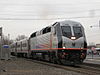 | 4000–4032 | 2005–2006 | Diesel | 4,200 hp (3,132 kW) 3,680 hp (2,744 kW) available for traction | ||
Bombardier ALP-46A |  | 4629–4664 | 2010–2011 | Electric | 7,500 hp (5,593 kW) |
| |
Bombardier ALP-45DP | 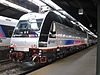 | 4500–4534, 4535-4551 | 2010–2011, 2018-Present | Dual-mode (electric and diesel) | Electric mode 5,365 hp (4,001 kW) Diesel mode 4,200 hp (3,132 kW) 3,000 hp (2,237 kW) available for traction |
| |
Retired revenue
| Builder and model | Photo | Numbers | Built | Acquired | Retired | Type | Power | Notes |
|---|---|---|---|---|---|---|---|---|
EMD F40PH-2CAT | 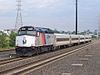 | 4113–4129 | 1981 | 1981 | 2014 | Diesel | 3,000 hp (2,237 kW) |
|
GE U34CH | 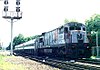 | 3351, 3360, 3366-3368, 3370-3373, 3376, 3380-3381, 4151-4183 | 1970–1971 | 1976 | 1994 | Diesel | 3,600 hp (2,700 kW) |
|
EMD GP40FH-2 | 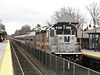 | 4130–4144 | 1966–1967 | 1987 | 2012 | Diesel | 3,000 hp (2,237 kW) |
|
EMD GP40PH-2A | 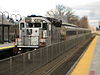 | 4145–4147, 4149–4150 | 1967–1971 | 1992–1993 | 2014 | Diesel | 3,000 hp (2,237 kW) |
|
GE P40DC | 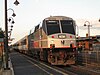 | 4800-4803 | 1993 | 2007 | 2015 | Diesel | 4,250 hp (3,170 kW) |
|
ABB ALP-44O | 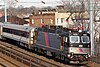 | 4400–4414 | 1989 | 1990 | 2011 | Electric | 7000 hp (5.2 MW) | *Replaced by ALP-46 and ALP-46A |
ABB ALP-44E | 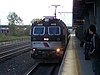 | 4415–4419 | 1995 | 1995 | 2012 | Electric | 7000 hp (5.2 MW) | *Replaced by ALP-46 and ALP-46A |
ABB ALP-44M |  | 4420–4431 | 1996 | 1996 | 2011 | Electric | 7000 hp (5.2 MW) | *Replaced by ALP-46 and ALP-46A |
GE E60CH | 958-973 | 1973 | 1984 | 1998 | Electric | 6,000 hp (4.5 MW) |
| |
GE/Altoona Works GG1 | 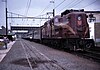 | 4972-4884 | 1934-1943 | N/A | 1983 | Electric | 4,620 hp (3,450 kW)-8,500 hp (6,300 kW) | *Ex-Pennsylvania Railroad |
EMD F7 | 417-418, 420, 422-425 | 1949-1993 | N/A | 1984 | Diesel | 1,500 hp (1,100 kW) | *Ex-CNW | |
EMD E8 | 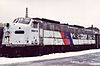 | 4320,4322-4328, 4330-4334 | 1949-1954 | N/A | N/A | Diesel | 2,250 hp (1,678 kW) | |
EMD F40PH | 270, 274, 293, 302, 311, 400 | 1975-1992 | N/A | 2006 | Diesel | 3,000–3,200 hp (2.2–2.4 MW) |
|
Non-revenue
All non-revenue locomotives are diesel-powered and legally carry the same "NJTR" AAR reporting marks as all other equipment without exception. As these locomotives lack HEP, they do not haul trains in passenger service unless performing a rescue.
| Model | Numbers | Year(s) | Notes |
|---|---|---|---|
EMD GP40-2 | 4300–4303 | 1965–1968 | Ex-Conrail and New York Central. |
EMD GP40PH-2 | 4102–4112 | 1968 | Modified starting in 2014. The HEP motor was removed, unlit number boards were drilled in, the rear ladder was replaced with steps, and LED markers were applied to the rear end replacing their original tri-color class lights. Units are now mechanically standard GP40-2s. |
MotivePower MP20B-3 | 1001–1005 | 2008 | Rebuilt from 1967 EMD GP40FH-2s 4130–4134. |
EMD F40PH-2CAT | 4119-4120 | 1979–1981, 2018-present | Regulated to work service since 2013. Recently reactivated in place of cab cars during shortage due to PTC installation. |
Passenger cars
NJ Transit has a fleet of over 1,000 passenger cars. The fleet and examples are described below.
Except for the Comet II (which are all trailers), all examples shown are cab cars leading or on the tail end of trains.
Car groupings are, except for the Arrow III MUs, arranged in the following order: cab cars, trailers with lavatories, and trailers without lavatories, where applicable.
Single Arrow III MU's are GE Model MA-1J, married pairs are GE Model MA-1H. NJ Transit also leased 10 MARC Train coaches in 2018 to alleviate an equipment shortage.[8]
| Builder and model | Photo | Numbers | Total | Built | Rebuilt (rebuilder) | Notes |
|---|---|---|---|---|---|---|
GE Arrow III | 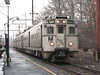 | 1304–1333 (singles) 1334–1533 (pairs) |
| 1977 | 1992–1995 (ABB) |
|
Bombardier Comet II | 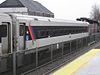 | 5300–5396, 5441–5458, 5460 |
| 1982–1983 | 1999–2003 (AAI/Alstom) | |
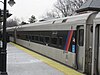 | 5397–5440, 5459 |
| 1987–1989 | |||
Bombardier Comet IV |  | 5011–5031, 5235–5264, 5535–5582 |
| 1996 |
| |
Alstom Comet V |  | 6000–6083, 6200–6213, 6500–6601 |
| 2002–2004 |
| |
Bombardier MultiLevel Coach |  | 7000–7051, 7200–7298, 7500–7677 |
| 2006–2010 |
| |
Bombardier MultiLevel Coach II | 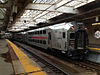 | 7052–7061, 7678–7767 |
| 2012–2013 |
| |
Bombardier MultiLevel Coach III |
| 2022- |
| |||
Stations
NJ Transit provides passenger service on 12 lines at total of 165 stations, some operated conjunction with Amtrak and Metro North (MNCW).[16]
References
^ "NJ Transit Facts at a Glance" (PDF). New Jersey Transit. Retrieved December 12, 2017..mw-parser-output cite.citation{font-style:inherit}.mw-parser-output .citation q{quotes:"""""""'""'"}.mw-parser-output .citation .cs1-lock-free a{background:url("//upload.wikimedia.org/wikipedia/commons/thumb/6/65/Lock-green.svg/9px-Lock-green.svg.png")no-repeat;background-position:right .1em center}.mw-parser-output .citation .cs1-lock-limited a,.mw-parser-output .citation .cs1-lock-registration a{background:url("//upload.wikimedia.org/wikipedia/commons/thumb/d/d6/Lock-gray-alt-2.svg/9px-Lock-gray-alt-2.svg.png")no-repeat;background-position:right .1em center}.mw-parser-output .citation .cs1-lock-subscription a{background:url("//upload.wikimedia.org/wikipedia/commons/thumb/a/aa/Lock-red-alt-2.svg/9px-Lock-red-alt-2.svg.png")no-repeat;background-position:right .1em center}.mw-parser-output .cs1-subscription,.mw-parser-output .cs1-registration{color:#555}.mw-parser-output .cs1-subscription span,.mw-parser-output .cs1-registration span{border-bottom:1px dotted;cursor:help}.mw-parser-output .cs1-ws-icon a{background:url("//upload.wikimedia.org/wikipedia/commons/thumb/4/4c/Wikisource-logo.svg/12px-Wikisource-logo.svg.png")no-repeat;background-position:right .1em center}.mw-parser-output code.cs1-code{color:inherit;background:inherit;border:inherit;padding:inherit}.mw-parser-output .cs1-hidden-error{display:none;font-size:100%}.mw-parser-output .cs1-visible-error{font-size:100%}.mw-parser-output .cs1-maint{display:none;color:#33aa33;margin-left:0.3em}.mw-parser-output .cs1-subscription,.mw-parser-output .cs1-registration,.mw-parser-output .cs1-format{font-size:95%}.mw-parser-output .cs1-kern-left,.mw-parser-output .cs1-kern-wl-left{padding-left:0.2em}.mw-parser-output .cs1-kern-right,.mw-parser-output .cs1-kern-wl-right{padding-right:0.2em}
^ "NJ Transit Facts at a Glance Fiscal Year 2012" (PDF). NJ Transit. March 2013. Retrieved March 23, 2014.
^ Rouse, Karen (November 16, 2012). "NJ Transit's rail fleet hit hard by storm". The Record. Retrieved August 11, 2013.
^ "NJ Transit to order more electro-diesels". International Rail Journal. December 8, 2017. Retrieved December 8, 2017.
^ Bombardier hands over first ALP-46A
^ Bombardier Press release
^ "NJ Transit to order more electro-diesels". International Rail Journal. December 8, 2017. Retrieved December 8, 2017.
^ "NJ Transit leasing cars from Maryland" (Press release). News 12 New Jersey. May 1, 2018.
^
"First Multilevel Train Debuts on Northeast Corridor" (Press release). NJ Transit. December 11, 2006. Retrieved January 13, 2007.
^ "NJ Transit Orders 45 Additional Multilevel Rail Cars" (Press release). NJ Transit. June 13, 2007. Retrieved June 13, 2007.
^ NJT Purchases 50 Additional Multilevel Rail Cars
^ Transit approves capital and operating budgets Asbury Park Press. Retrieved July 14, 2010.
^ News - Media Centre - Bombardier
^ "NJ Transit pays $267M to purchase 100 new rail cars". Associated Press. September 2, 2009. Retrieved July 29, 2011.
^ abcde "NJ Transit orders double-deck EMUs from Bombardier". Railway Gazette International. December 13, 2018. Retrieved December 20, 2018.
^ "New Jersey Transit At A Glance" (PDF). New Jersey Transit. 2014. Retrieved December 25, 2015.
External links
 | Wikimedia Commons has media related to New Jersey Transit rail operations. |

- NJ Transit
- NJ Transit Rail
- Draft 2012 State Rail Plan
NJ Transit Rail Operations | ||
|---|---|---|
| Hoboken Division |
|  |
| Newark Division |
| |
| Connections |
| |
| Current rolling stock |
| |
| Bridges and tunnels |
| |
| Stations and yards |
| |
| Proposed lines |
| |
| Other topics |
| |
NJ Transit | ||
|---|---|---|
| Divisions |
|  |
| Enforcement | New Jersey Transit Police Department | |
| Fleet |
| |
| Other templates |
| |


