Terrebonne, Quebec
 | This article may be expanded with text translated from the corresponding article in French. (March 2012) Click [show] for important translation instructions.
|
Terrebonne | ||
|---|---|---|
City | ||
| Ville de Terrebonne | ||
 | ||
| ||
 Location (red) within Les Moulins RCM. | ||
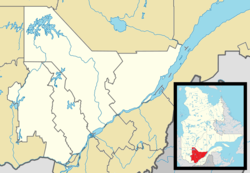  Terrebonne Location in central Quebec. | ||
| Coordinates: 45°42′N 73°38′W / 45.700°N 73.633°W / 45.700; -73.633Coordinates: 45°42′N 73°38′W / 45.700°N 73.633°W / 45.700; -73.633[1] | ||
| Country |  Canada Canada | |
| Province |  Quebec Quebec | |
| Region | Lanaudière | |
| RCM | Les Moulins | |
| Settled | 1673 | |
| Constituted | June 27, 2001 | |
| Government [3] | ||
| • Mayor | Marc-André Plante[2] | |
| • Governing Body | Terrebonne City Council | |
| • Federal riding | Terrebonne | |
| • Prov. riding | L'Assomption / Masson / Terrebonne | |
| Area [3][4] | ||
| • Total | 158.60 km2 (61.24 sq mi) | |
| • Land | 154.74 km2 (59.75 sq mi) | |
| Population (2016)[5] | ||
| • Total | 111,575 | |
| • Density | 687.1/km2 (1,780/sq mi) | |
| • Pop 2006–2011 |  12.3% 12.3% | |
| Time zone | UTC−5 (EST) | |
| • Summer (DST) | UTC−4 (EDT) | |
| Postal code(s) | J6V to J6Y, J7M | |
| Area code(s) | 450 and 579 | |
Highways  A-25 A-25 A-640 A-640 |  Route 125 Route 125  Route 337 Route 337  Route 344 Route 344 | |
| Website | www.ville. terrebonne.qc.ca | |

Terrebonne is an off-island suburb of Montreal, in western Quebec, Canada. It is located on the north shores of the Rivière des Mille-Îles and of the Rivière des Prairies, North of Montreal and Laval.
This city is divided in three sectors, namely Lachenaie, La Plaine and Terrebonne. In the past, these sectors were distinct cities, but, on 22 August 2001, they merged under the name of Terrebonne. According to the 2011 Canadian Census Terrebonne has a population of 111,575,[5] making it Montreal's fourth largest suburb.
Contents
1 History
2 Infrastructure
3 Demographics
3.1 Population
3.2 Language
4 Education
4.1 University
4.2 CEGEP
4.3 Vocational studies
4.4 Primary and secondary schools
5 Monuments and historic sites
5.1 Île-des-moulins
5.2 Moulin-Neuf dam
5.3 Ecclesiastical architecture
6 Sister cities
7 Sports
8 References
9 External links
10 See also
History

Terrebonne in 1810
The town of Lachenaie, which was founded in 1670 by Lord Charles Aubert de Lachenaye, is the oldest of the three towns that were merged.[citation needed] Some natives were already present on this territory at the time. The colonisation really started in 1647 when Lachenaie was merged with the Repentigny Seigniory. Louis Lepage de Ste-Claire, priest, canon, and the son of René Lepage de Sainte-Claire, acquired the Seigniory of Terrebonne on 2 September 1720. Abbot Louis Lepage de Ste-Claire built the first church in 1734 and the first manor in 1735. A few years later, Abbot Lepage equipped the town with both a saw mill and a flour mill.
The town of La Plaine was founded in 1830 on fragments of other towns, namely Mascouche, Sainte-Anne-des-Plaines, Saint-Lin, and Terrebonne. At that time, the lords of Terrebonne and Lachenaie built the road named "chemin de la Grande Ligne" to join the two towns. It is now called the boulevard Laurier. In 1877, the rail system was developed and stimulated the economic growth. The village of Saint-Joachim was founded during that time, which was later, in 1920, to be renamed La Plaine.
The first lord of Terrebonne was André Daulier-Deslandes, who was granted his title in 1673. Following the construction of the first wooden bridge in 1834, two main areas emerged. The commercial area was Terrebonne, while the agricultural one was Saint-Louis de Terrebonne. In 1985, these two cities merged.
At the time of the municipal merger in late August 2001, Lachenaie had over 20,000 residents, La Plaine had 17,000 residents, and Terrebonne had almost 46,000 residents. This merger made Terrebonne the 10th largest city in Quebec. Ten years later, the city had around 106,322 citizens on 154.6 km2 (59.7 sq mi) of land, according to the 2011 Canadian Census.[4]
Infrastructure
Terrebonne is connected to Montreal's Central Station by commuter rail via the Terrebonne station of the Réseau de transport métropolitain (RTM) Mascouche line.
The city of Terrebonne is also equipped with a bus network, also operated by the RTM, which enables residents to reach several metro stations both in Laval and Montreal, amongst many other locations. Some examples include bus line 30 (or 30G), which brings inhabitants of Terrebonne to the Radisson metro station on Sherbrooke Street East, bus line 19 (or 19G), which reaches Montmorency metro station in Laval, and bus line 25, whose terminal stop is at the Henri-Bourassa metro station.
Demographics
Population
| Canada census – Terrebonne, Quebec community profile | |||
|---|---|---|---|
2011 | 2006 | ||
| Population: | 106,322 (+12.3% from 2006) | 94,703 (+17.6% from 2001) | |
| Land area: | 154.74 km2 (59.75 sq mi) | 154.60 km2 (59.69 sq mi) | |
| Population density: | 687.1/km2 (1,780/sq mi) | 612.6/km2 (1,587/sq mi) | |
| Median age: | 37.1 (M: 36.6, F: 37.5) | 36.3 (M: 35.8, F: 36.7) | |
| Total private dwellings: | 40,282 | 35,859 | |
| Median household income: | $68,841 | $62,933 | |
| References: 2011[4] 2006[6] earlier[7] | |||
Historical Census Data - Terrebonne, Quebec[8] | |||||||||||||||||||||||||||||
|---|---|---|---|---|---|---|---|---|---|---|---|---|---|---|---|---|---|---|---|---|---|---|---|---|---|---|---|---|---|
|
|
| |||||||||||||||||||||||||||
(A) adjustment due to boundary change | |||||||||||||||||||||||||||||
Language
| Canada Census Mother Tongue - Terrebonne, Quebec[8] | ||||||||||||||||||
|---|---|---|---|---|---|---|---|---|---|---|---|---|---|---|---|---|---|---|
| Census | Total | French | English | French & English | Other | |||||||||||||
| Year | Responses | Count | Trend | Pop % | Count | Trend | Pop % | Count | Trend | Pop % | Count | Trend | Pop % | |||||
2016 | 111 130 | 97 765 | 8.0% | 87.8% | 2 435 | 17.4% | 2.19% | 730 | 59.3% | 0.65% | 8 925 | 51.9% | 8.03% | |||||
2011 | 105,125 | 95,940 | 9.1% | 91.26% | 2,190 | 51.14% | 2.08% | 685 | 5.83% | 0.65% | 6,310 | 41.44% | 6.00% | |||||
2006 | 94,385 | 87,935 | 115.8% | 93.17% | 1,865 | 122.0% | 1.98% | 430 | 132.4% | 0.45% | 4,155 | 324.0% | 4.40% | |||||
2001 | 42,745 | 40,740 | 1.8% | 95.31% | 840 | 0.6% | 1.97% | 185 |  13.9% 13.9% | 0.43% | 980 | 24.8% | 2.29% | |||||
1996 | 41,835 | 40,000 | n/a | 95.61% | 835 | n/a | 2.00% | 215 | n/a | 0.51% | 785 | n/a | 1.88% | |||||
Education
University
The Université de Montréal has a small campus located near the Pierre Le Gardeur Hospital in the Lachenaie sector of the city of Terrebonne. There are also some courses given by the Université du Québec à Montréal in the Terrebonne sector near the Cégep régional de Lanaudière à Terrebonne.
CEGEP
The Cégep régional de Lanaudière network has established a collegial institution, namely the Cégep régional de Lanaudière à Terrebonne, near Highway 640, in the Terrebonne sector of the city of Terrebonne.
Vocational studies
The city of Terrebonne counts several vocational education centers. The Centre de formation professionnelle des moulins is located next to the Cégep régional de Lanaudière à Terrebonne in the Terrebonne sector.
Primary and secondary schools
French-language public schools in Terrebonne Ouest are operated by the Commission scolaire de la Seigneurie-des-Mille-Iles (CSSMI).[9] Additionally, some schools within and serving the city of Terrebonne are operated by the French Commission scolaire des Affluents and the English Sir Wilfrid Laurier School Board.
Commission scolaire des Affluents secondary schools include:
- École secondaire Armand-Corbeil
- École secondaire de l’Odyssée
- École secondaire Des Rives
- École secondaire des Trois-Saisons
CSSMI primary schools:
- de l'Espace-Couleurs[10]
- Jeunes du monde[11]
- Marie-Soleil-Tougas[12]
Some CSSMI sections are zoned to École primaire Le Carrefour in Lorraine. The CSSMI secondary schools serving Terrebonne are: École secondaire du Harfang in Sainte-Anne-des-Plaines, École secondaire Hubert-Maisonneuve (lower secondary) in Rosèmere and École secondaire Rive-Nord (upper secondary) in Bois-des-Filion.[13]
Private Francophone secondary schools include:
- Collège Saint-Sacrement
Anglophone public schools serving Terrebonne include:
- McCaig Elementary School in Rosemère serves western Terrebonne[14]
- Pinewood Elementary School in Mascouche serves a central portion[15]
- Franklin Hill Elementary School in Repentigny serves an eastern portion[16]
Rosemere High School (all areas) in Rosemere[17]
Monuments and historic sites
Île-des-moulins
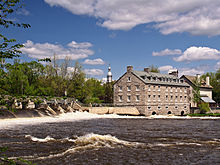
The Moulin neuf (New Mill) at the Île-des-moulins
The pre-industrial complex of the Île-des-moulins was amongst the most important ones in the province of Quebec during the 19th century. Although several infrastructures have degraded, a total of five buildings remain. The fourth lord of Terrebonne, Abbot Louis Lepage, had ordered the construction of the first flour mill in 1721 as well as the first saw mill around 1725.
In 1803, the bakery was built and established in the village. The actual saw and flour mills were built in 1804 and 1846, respectively. Four years following the construction of the flour mill that is currently standing at the Île-des-moulins to this day, the Moulin neuf (New Mill) was built in 1850. In addition, around the same time in 1850, the seigniory office was established.
In 1973, the Île-des-moulins was classified as a historic site of national interest by the Government of Quebec.[18]
Moulin-Neuf dam

The actual Moulin-Neuf dam with the pedestrian walkway at the Île-des-moulins in Terrebonne
The Moulin-Neuf dam allows for the flow regulation of the Rivière des Mille Îles, as well as ice accumulation control in the spring.
The first dam at the Île-des-moulins was built in 1721, following the establishment of the very first flour mill. This dam linked the Île-des-moulins to the Ile Saint-Jean, passing through the small Île aux moutons, located midway between the two islands in the Rivière des Mille Îles.
In 1872, the Masson family ordered the construction of a new dam near the location of the current historical one. However, this dam was rebuilt in cement in the year 1890 for reinforcement and increased resilience.
Nearly a century later, in 1972, the owner of the Île-des-moulins decided to destroy the dam with dynamite due to flooding risk. As a result, the dam underwent severe damage, prompting the city of Terrebonne to acquire the island and classify it as a protected historical site in 1973.
In 1979, the Ministère des Richesses naturelles du Québec ordered the reconstruction of the Moulin-Neuf dam, to which a pedestrian walkway is added to allow citizens, visitors, and tourists to walk from the Île-des-moulins to the larger Ile Saint-Jean. This new dam was built a certain distance away from the small Île aux moutons, making the dam significantly longer than the initial ones.

A picture of the Rivière des Mille Îles in Terrebonne, in which the Île Saint Jean the Île aux moutons and the Île-des-moulins can be seen from left to right, respectively.
Ecclesiastical architecture
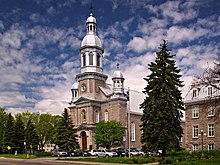
The Saint-Louis-de-France Church in Terrebonne
The actual Saint-Louis-de-France Church in the Old Terrebonne (Vieux Terrebonne), near the historical site of the Île-des-moulins, was established in 1878, while the parish was founded in 1723 by Louis Lepage de Sainte-Claire, priest of the diocese of Quebec, parish priest of the Île Jésus, and lord of the Seigniory of Terrebonne. The parish was part of the diocese of Saint-Jérôme.
The current Saint-Louis-de-France Church built around the year 1878, the third since the foundation of the parish, was equipped with a Casavant organ in 1946.
In 1880, parish priest Piché, informally known as the bon monsieur Piché ("Good Mister Piché" in English), exhumed the bodies buried in the basement of the old church in order to place them in the crypt of the new one.
Sister cities
 Vitré (France) 1983
 Vitré (France) 1983
Sports
The Terrebonne Cobras are part of the QJHL.
References
^ Reference number 62093 of the Commission de toponymie du Québec (in French)
^ Municipal council
^ ab Geographic code 64008 in the official Répertoire des municipalités (in French)
^ abc "2011 Community Profiles". 2011 Canadian Census. Statistics Canada. July 5, 2013. Retrieved 2014-05-18..mw-parser-output cite.citation{font-style:inherit}.mw-parser-output q{quotes:"""""""'""'"}.mw-parser-output code.cs1-code{color:inherit;background:inherit;border:inherit;padding:inherit}.mw-parser-output .cs1-lock-free a{background:url("//upload.wikimedia.org/wikipedia/commons/thumb/6/65/Lock-green.svg/9px-Lock-green.svg.png")no-repeat;background-position:right .1em center}.mw-parser-output .cs1-lock-limited a,.mw-parser-output .cs1-lock-registration a{background:url("//upload.wikimedia.org/wikipedia/commons/thumb/d/d6/Lock-gray-alt-2.svg/9px-Lock-gray-alt-2.svg.png")no-repeat;background-position:right .1em center}.mw-parser-output .cs1-lock-subscription a{background:url("//upload.wikimedia.org/wikipedia/commons/thumb/a/aa/Lock-red-alt-2.svg/9px-Lock-red-alt-2.svg.png")no-repeat;background-position:right .1em center}.mw-parser-output .cs1-subscription,.mw-parser-output .cs1-registration{color:#555}.mw-parser-output .cs1-subscription span,.mw-parser-output .cs1-registration span{border-bottom:1px dotted;cursor:help}.mw-parser-output .cs1-hidden-error{display:none;font-size:100%}.mw-parser-output .cs1-visible-error{font-size:100%}.mw-parser-output .cs1-subscription,.mw-parser-output .cs1-registration,.mw-parser-output .cs1-format{font-size:95%}.mw-parser-output .cs1-kern-left,.mw-parser-output .cs1-kern-wl-left{padding-left:0.2em}.mw-parser-output .cs1-kern-right,.mw-parser-output .cs1-kern-wl-right{padding-right:0.2em}
^ ab Statistics Canada, 2016 Census of Population
^ "2006 Community Profiles". 2006 Canadian Census. Statistics Canada. March 30, 2011. Retrieved 2014-05-18.
^ "2001 Community Profiles". 2001 Canadian Census. Statistics Canada. February 17, 2012.
^ ab Statistics Canada: 1996, 2001, 2006, 2011 census
^ "Admission et inscription Archived 2015-01-31 at the Wayback Machine.." Commission scolaire de la Seigneurie-des-Mille-Iles. Retrieved on December 7, 2014. "La Commission scolaire de la Seigneurie-des-Mille-Iles (CSSMI) offre ses services aux résidents des municipalités de : Blainville, Boisbriand, Bois-des-Filion, Deux-Montagnes, Lorraine, Mirabel (Saint-Augustin, Saint-Benoît, Sainte-Scholastique et secteur du Domaine-Vert), Oka, Pointe-Calumet, Rosemère, Sainte-Anne-des-Plaines, Sainte-Marthe-sur-le-Lac, Sainte-Thérèse, Saint-Eustache, Saint-Joseph-du-Lac, Saint-Placide et Terrebonne Ouest."
^ "de l'Espace-Couleurs." Commission scolaire de la Seigneurie-des-Mille-Iles. Retrieved on September 20, 2017.
^ "Jeunes du monde." Commission scolaire de la Seigneurie-des-Mille-Iles. Retrieved on September 20, 2017.
^ "Marie-Soileil-Tougas." Commission scolaire de la Seigneurie-des-Mille-Iles. Retrieved on September 20, 2017.
^ "Répertoire des aires de desserte par ville 2017 - 2018 (Généré le 20/9/2017) Terrebonne." Commission scolaire de la Seigneurie-des-Mille-Iles. Retrieved on September 20, 2017.
^ "McCAIG ELEMENTARY ZONE." Sir Wilfrid Laurier School Board. Retrieved on September 16, 2017.
^ "PINEWOOD ELEMENTARY ZONE." Sir Wilfred Laurier School Board. Retrieved on September 17, 2017.
^ "FRANKLIN HILL ELEMENTARY ZONE." Sir Wilfred Laurier School Board. Retrieved on September 17, 2017.
^ "Rosemere High School Zone." Sir Wilfred Laurier School Board. Retrieved on December 8, 2014.
^ Interpretation Panel of the Île-des-moulins Historical Circuit, Terrebonne, Québec.
External links
 | Wikimedia Commons has media related to Terrebonne, Quebec. |
Terrebonne's official site (French only)
See also
Saint Pierre River (Mascouche), a river
Mascouche River, a river
Rivière des Mille Îles, a river
Adjacent Municipal Subdivisions | ||||||||||
|---|---|---|---|---|---|---|---|---|---|---|
| ||||||||||

 Terrebonne

 Subdivisions of Les Moulins Regional County Municipality Subdivisions of Les Moulins Regional County Municipality | |
|---|---|
| Cities |
|
| |


